May 2021

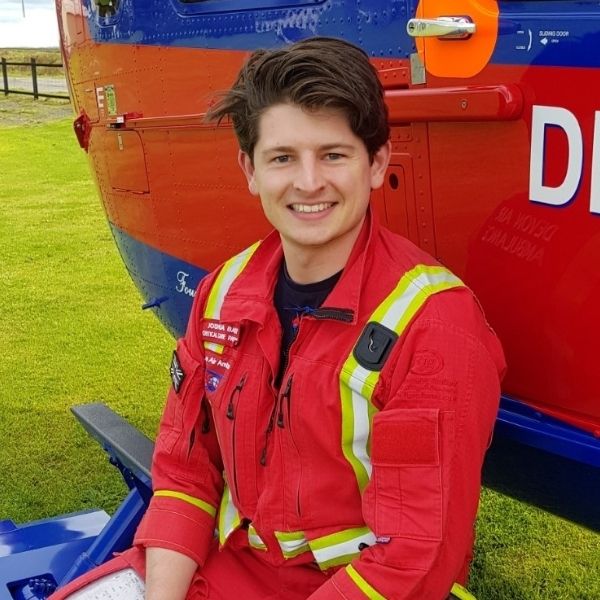
Critical Care Paramedic Josh Barker

Becoming a Critical Care Paramedic

By Clinical, Patient Support

Specialist Paramedic in Critical Care, Josh Barker, shares his experience of qualifying to be a paramedic and the study and training involved in becoming established in the role.

I feel incredibly lucky and thankful to be working for a Critical Care and HEMS service, as it is one of the most competitive and sought-after job positions in prehospital medicine, among paramedics and doctors alike. The role of Specialist Paramedic in Critical Care with Devon Air Ambulance is a position I feel very fortunate to have achieved.

How do you become a Critical Care Paramedic?

My journey began before ever having thought about stepping inside a helicopter. My colleagues and I began our careers working for frontline ambulance services attending 999 calls.

Some colleagues worked in roles of Care Assistant and Technician before qualifying as a Paramedic. Others, like me, worked as direct-entry graduate paramedics having completed a degree at university.

What’s required next is to consolidate the qualification with experience, working on the road to develop our practice, clinical acumen and confidence in managing a variety of sick and injured patients. Most air ambulances ask for a minimum of 3 -5 years of post-registration experience before you can be considered for interview.

Preparing for a HEMS application

In addition to the development of clinical skills through working as a paramedic, and the continued professional development that is required in this role, HEMS applicants are expected to demonstrate additional experience to help them stand out.

In becoming a specialist practitioner, it’s helpful if candidates can display how they meet the 4 Pillars of Advanced Practice: Clinical Excellence, Education, Leadership and Research.

Therefore, having some clinical teaching experience or mentorship is useful, as well as taking part in quality improvement projects or research.

Most of these opportunities are available whilst working in the ambulance service, but it will probably require some additional hours invested, volunteering your time to get a variety of experience.

Working for a charity

Finally, it’s important to recognise that often, in the UK, working for a HEMS unit means working for a charity.

This adds a further dimension to your role as a Critical Care Paramedic, in that it is important to help the charity achieve its aims and to support fundraising. Without the support of local communities, air ambulance charities couldn’t function; it is important that the clinical crew understand this.

Many of us donate some of our time to the charity to attend functions or county shows where there may be a charity or fundraising stall. We engage with the charity’s supporters and volunteers to help demonstrate where their donations go.

As we are the ones delivering the front-line patient care, our presence is valuable to the charity as we are best-placed to explain why critical care is so important and exactly how the air ambulance can make a difference.

Most services will want to know that their applicants will embrace this ethos, so charity and volunteer experience can go a long way to demonstrate this on your CV.

Training to be a Specialist Paramedic in Critical Care (SPCC)

The learning curve to be a SPCC is quite dramatic. In addition to learning to become a critical care provider, HEMS paramedics generally also have an additional role as a Helicopter Emergency Medical Service Technical Crewmember (HTC). This is a recognised aviation role and so we come under some of the regulations that govern pilots and other flight crew.

Training comprises a 3-week programme covering aviation principles and legislation, basic understanding of the systems on board the helicopter, refuelling, navigation, meteorology and various other subjects that allow us to contribute to the safe operation of the aircraft. We then must hone these skills in practice as part of the operational crew assisting with HEMS site selection, night flying and radio communications.

Education designed by Devon Air Ambulance

I am currently (May 2021) two thirds of the way through a 3-year Master’s programme that has been designed by Devon Air Ambulance to cover the advanced training and education requirements that are part of becoming an SPCC.

This course covers subjects from: advanced diagnostic reasoning, anaesthetic and ventilation principles, critical care medicine, as well as research and critical analysis modules. This is a key part of training to be a SPCC, but it’s also combined with daily simulation on-base, reflection on every case we attend, and in-depth governance sessions where the team learns from each other’s experiences. Although I’m almost at the end of my formal training, the learning never stops as the pathologies we encounter are so diverse and our clinical skill set is constantly adjusting.

It’s certainly a long journey to becoming a Specialist Paramedic in Critical Care, but it is definitely worth it as the role is incredibly rewarding.

Josh is very happy to respond to questions on his experience and to expand on his discussion here. Contact him at: j.barker@daat.org

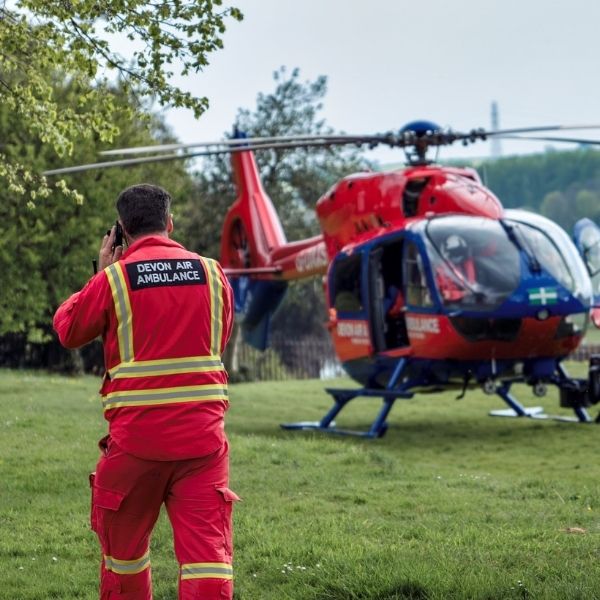
GDAAS 2021 Exeter Quay, Paramedic Paul Robinson approaching the aircraft

Chelton collaboration promotes awareness of good communication in service

By Operations

Chelton Aerospace Connectivity provides Chelton Tetra radio systems for air ambulances across the UK including Devon Air Ambulance among them.

We recently collaborated with Chelton to create a film to raise awareness of the work air ambulance charities, like Devon Air Ambulance, undertakes daily to save lives, and to talk about how missions are aided by effective radio and audio systems.

Our Operations Manager, and Specialist Paramedic in Critical Care, Darren Goodwin says:

We regularly need to communicate by radio with colleagues in the police service, the ambulance service and even the fire service. Having an integrated system in both our helicopters is absolutely paramount. The Tetra System is not only robust and simple to use, but it means we can have point-to-point communications with the scene to make sure we get early updates on the condition of the patient. That means we can tailor the care when we arrive at scene.

‘Mission safety is critical to us here at Devon Air Ambulance. The Tetra System enables us not only to speak to our colleagues on the ground, but it also enables us to have point-to-point communications with other helicopters, other air ambulances or police helicopters responding to the same incident. This not only increases our situational awareness, but it increases our aviation safety when responding to an incident.

‘The system also enables us to speak to patients at the scene of an incident. This can be very valuable, especially when we require specific information, so we might be looking to locate the patient in a remote, rural location, such as Dartmoor or one of the coastal paths around Devon.

‘It also enables us to speak to patients or bystanders at incidents to gather further information about the condition of the patient while we are en-route. This can help us to plan our mission and our onward transport to specialist treatment centres, or for us to prepare to deliver our enhanced or critical care when we arrive at scene.’

With thanks to Credit RaffStarStudio Rafal Zakrewski for the image.
Please note, that in the video Chelton Aerospace Connectivity may be referred to as Cobham and has since been rebranded.